Up to 6 Weeks Free Base Rent*
Find your new home today!
*Select homes only. Applies to base rent only. Min. Term & restrictions apply. Pricing, availability, and offer may change. See leasing agent for details


If you ask a local to point to the "South End," it could be difficult for them to give a precise answer. It is less of a strict geographical boundary and more of an open concept—a broad regional identity that covers the entire, diverse collection of neighborhoods south of downtown Seattle.
While the South End is a shared community mindset, its main physical and structural backbone is the Rainier Valley. This is the actual geographic basin running right down the middle, shaped by distinct natural and structural borders:
The broader South End is less of standard urban grid, and more like a collection of distinct small towns, each with its own history, flavor, and community roots.
While people use these terms interchangeably, locals draw a clear line between the two:
The Ridge and Gateway
These neighborhoods sit at the northern entrance to the South End and occupy the high hills, offering some of the city's best views alongside quick transit access to downtown.
Mount Baker: The northern gateway to the South End, this neighborhood has two distinct sides. Up on the ridge and along the shoreline, it features historic mansions and Mount Baker Park, a prime waterfront hangout with views of the Cascade Mountains. Down the hill on Rainier Avenue, it shifts into a busy transit hub anchored by the light rail and historic Franklin High School, marking the entrance into the valley.
Beacon Hill: Stretching four miles along the ridge above the valley, this large neighborhood is a South End cornerstone. It is known for its historic early-1900s Craftsman bungalows, Jefferson Park—which offers public golfing and some of the city's best skyline views—and a food scene concentrated around the light rail station.
Rainier Corridor
This is the flat bottom of the basin centered entirely along Rainier Avenue and MLK Way, acting as the main hub for walkable business districts, diverse food scenes, and light rail stops.
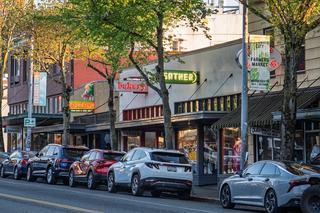
Columbia City: Originally an independent town annexed in 1907, this neighborhood is known for its historic landmark district along Rainier Avenue that's lined with brick storefronts, restaurants, and a popular farmers market. Outside of this commercial core, the neighborhood features quiet residential streets, historic homes, and easy access to the light rail.
Hillman City: Located just south of Columbia City along Rainier Avenue, this smaller neighborhood functions as a quieter, less commercial extension of its neighbor. It is a relaxed, mostly residential area anchored by family-owned storefronts, local coffee shops, and community spaces that give it a distinct small-scale feel.
Othello & NewHolly: A modern, mixed-income community named after South Othello Street and a completely rebuilt 1940s public housing site. The area around the light rail station features a dense mix of newer townhomes, mid-rise apartments, and single-family houses, sitting alongside a diverse selection of East African and Southeast Asian markets.
The Lakefront and Lower Valley
Located near the southern end of the city limits, these areas sit right along Lake Washington, trading busy transit corridors for a slower pace, expansive parks, and open water views.
Seward Park: Named after the 300-acre wooded peninsula that juts into Lake Washington, this quiet neighborhood is a major outdoor recreation hub. The park itself is a designated international "Urban Quiet Park," featuring a rare city pocket of old-growth forest and a flat, 2.4-mile paved shoreline loop with unobstructed views of the lake and Mount Rainier.
Rainier Beach: Wrapping around the southern tip of Lake Washington, this residential neighborhood is built around its waterfront views and community spaces. It is home to Seattle’s largest urban agriculture project—the 8-acre Rainier Beach Urban Farm and Wetlands. Sots like Be'er Sheva Park and Pritchard Island Beach offer swimming and lakefront paths.
Architectural Character, Block-by-Block Style: Unlike newer parts of Seattle that can feel uniform and clinical, the South End possesses a highly dynamic, historic streetscape that reflects over a century of continuous growth. For example, because Columbia City was originally an independent town annexed in 1907, it retains a distinct, walkable historic landmark district lined with early-1900s brick storefronts.
Mount Rainier Visual Alignment: A unique twist of glacial geography forces the 4.5-mile trough of the Rainier Valley to point directly southeast. Clear days bring a spectacular regional perk: when the mountain is "out," the snow-capped peak of Mount Rainier serves as a massive visual anchor across the entire South End corridor.
Effortless, Street-Level Transit Access: Unlike downtown stations buried deep underground, the South End's light rail runs directly at street level. Spanning four miles down MLK Way, open-air platforms let you skip the subway tunnels and hop straight onto the train. From Columbia City, you can reach downtown Seattle in under 20 minutes and SeaTac Airport in 20.
Botanical Sanctuaries: While Seattle is famous for standard pine-forested parks, the South End also holds a concentration of unique natural environments. Seward Park is a 300-acre lakefront peninsula containing a 2.4-mile shoreline loop and a rare, 120-acre interior pocket of untouched old-growth forest where bald eagles nest. Just down the road is Kubota Garden, a historic 20-acre public sanctuary of waterfalls, ponds, and hand-carved stone bridges.
Integrated Multiculturalism
You'll hear over 60 languages spoken on any given day across the district. Instead of separate, isolated enclaves, a single neighborhood stretch will bring you past an independent Vietnamese bakery, an East African community center, a traditional carniceria, and a seasonal community farm stand—all reflecting the deep, multi-generational roots of the Valley.
Combining a charming historic district with the South End's effortless transit access, Columbia City gives you a perfect balance of small-town community feel and urban connectivity. Living at Arlo puts it all right at your doorstep.